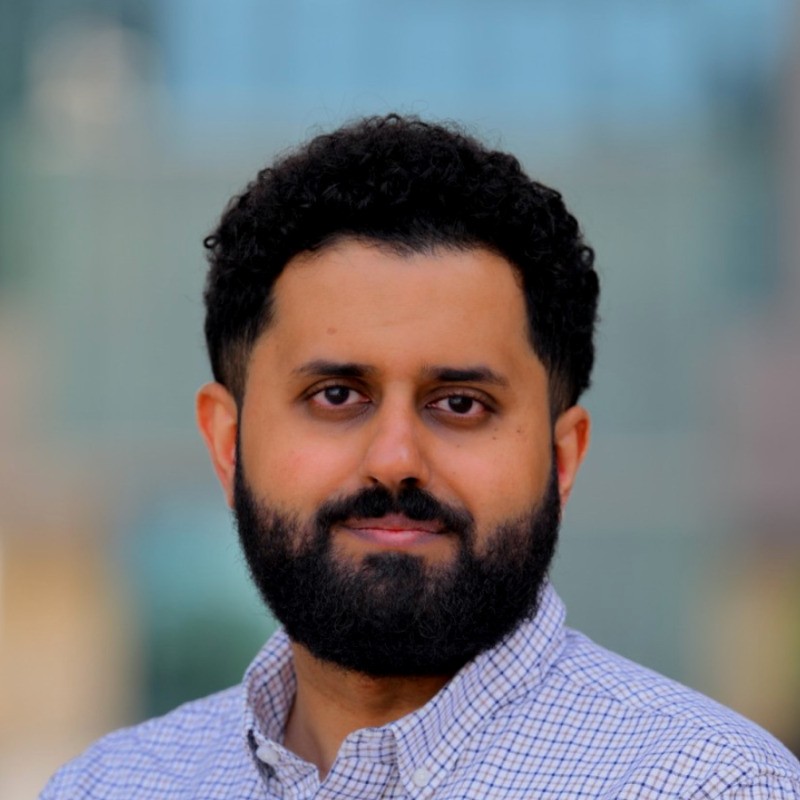
I am a quantitative researcher and startup founder working at the intersection of applied mathematics, scientific computing, and artificial intelligence. I build mathematical models and computational systems that make complex, high-dimensional problems tractable, uncertainty-aware, and usable in practice.
I earned my PhD in Applied Mathematics and Computational Sciences from KAUST, and I hold a BSc in Physics with a minor in Mathematics from the University of Washington, Seattle. My research focuses on computational methods for parametric systems, especially surrogate modeling, probabilistic inference, adaptive sampling, eigensolution tracking, and low-rank (tensor-train) representations.
Increasingly, my focus is on turning rigorous ideas into real products. Through LandSense, I am building an intelligence platform for Saudi real estate brokers in a market where transaction, geospatial, and regulatory signals are fragmented across disconnected systems and workflows. The goal is to stitch those signals into coherent, reliable, uncertainty-aware, and explainable tools for portfolio strategy and off-market opportunity discovery.
Key areas spanning probabilistic modeling, data compression, and computational methods.
Kernel functions serve as the common thread connecting Gaussian processes, state-space models, and neural network approximations. The focus is on making inference scale to large problems while keeping predictions well-calibrated, robust, and interpretable.
Tensor-train decompositions break high-dimensional data into chains of small matrices, keeping costs manageable even as the number of dimensions grows. These compact representations can stand in for full simulation models or large covariance structures, enabling faster computation without sacrificing accuracy.
When a simulation depends on many parameters, running it for every combination is impractical. Adaptive sampling and reduced-order techniques build lightweight stand-ins that come with accuracy guarantees, making it feasible to explore large design spaces and track how solutions change across parameters.
Published work and forthcoming papers.
ECCOMAS Congress, Oslo (2022)
Introduced a similarity-based framework for consistently matching eigensolutions across parameter instances in parametric PDEs, enabling stable tracking of eigenbranches and supporting greedy reduced-order modeling and surrogate construction for high-dimensional spectral problems.
Journal of Computational and Applied Mathematics
Developed a certified greedy model order reduction algorithm for parametric elliptic PDEs, combining adaptive sampling with rigorous a posteriori error estimation to construct compact reduced bases with provable accuracy and scalable complexity.
Computational Methods in Applied Mathematics
Proposed a Gaussian process-based, data-driven surrogate modeling approach for parametric PDE eigenvalue problems, enabling accurate and uncertainty-aware approximation of eigenvalue trajectories in non-affine and irregular parameter regimes.
Extended earlier eigensolution matching techniques to a scalable continuation framework for high-dimensional parametric eigenvalue problems, enabling reliable tracking of spectral branches and reduced-order modeling in applications such as linear elasticity.
Active lines of work connecting the research areas above.
Combining tensor-train decomposition with neural networks and Gaussian processes to build hybrid surrogates that scale to high-dimensional parameter spaces. The tensor-train format provides structure and compression, while ML components handle the nonlinearities and uncertainty that arise in complex simulations.
Extending certified greedy algorithms with data-driven parameter selection and ML-based classification of eigensolutions. The goal is to let the algorithm learn where to sample next, rather than relying on exhaustive sweeps, making reduced-order modeling practical in higher dimensions.
Building symbolic algorithms for the automated detection of discrete symmetries in evolution equations - going beyond classical Lie symmetry methods to uncover structure that can simplify analysis and reduce computational cost.
NumPDE Workshop, KAUST
Contributed Talk
European Congress of Mathematics (ECM), Seville
Invited Talk
Lions-Magenes Days, Pavia
Poster
7th Chilean Workshop on Numerical Analysis of PDEs
Contributed Talk
28th International Conference on Domain Decomposition Methods
Contributed Talk
29th Biennial Numerical Analysis Conference, Strathclyde
Contributed Talk
ECCOMAS Congress, Oslo
Contributed Talk
ICTP Summer School on Advances in Condensed Matter Physics, Samarkand
Workshop
AMCS 131 (Vector Calculus & Differential Equations) and AMCS 202 (Applied Mathematics II). Responsibilities included leading recitations, grading, and organizing the Winter School for students needing remediation.
Taught short courses and received the Best Teacher Award for outstanding instruction.
Supervised Andrea Panozzo, whose Master’s thesis was partially based on my PhD research.
Prestigious full-ride undergraduate scholarship awarded by KAUST, supporting academic excellence abroad.
Full-ride scholarship covering tuition and expenses during studies at the University of Washington.
Covers tuition and housing, in addition to providing a monthly stipend during PhD studies.
Python (NumPy, Pandas, Scikit-learn, Flask, Pydantic), MATLAB, Mathematica
Gradient boosting, prediction intervals, model explainability, Gaussian processes, Kernel regression, geospatial feature engineering
PostgreSQL, Redis, Parquet, GeoPandas, ETL pipelines
AWS (EC2, RDS, Lightsail), Docker, health monitoring
Anthropic Claude API, Model Context Protocol (MCP)
Git (multi-repo submodules), GitHub, Jupyter, VS Code, LaTeX