Mesh independence
Does the adaptive sweep depend on the spatial mesh, or only on the underlying continuous eigenproblem? This page tests that question on the 2-D diffusion eigenproblem with a one-parameter coefficient: the same parameter sweep is run at three mesh resolutions, and the adaptive grid, the reduced-order-model accuracy, and the eigenvector subspaces are compared across them. If the algorithm is discretisation-free in the intended regime, all three resolutions should agree — and the ROM-vs-dense equivalence reported elsewhere should not be an artefact of one particular mesh.
What’s being tested
The one-parameter diffusion sweep is run at three P1 mesh resolutions, \texttt{mesh\_n} \in \{15, 30, 60\}, holding the tolerance tuple fixed: relative pruning threshold t_\pi = 0.21, eigenvalue-cluster threshold t_\lambda = 10^{-3}, and n_{\text{eigs}} = 4 bands tracked per parameter point. Three quantities are compared across the three meshes:
- Verdict-tuple convergence — the per-level count tuple (n_{\text{points}}, n_{\text{subintervals}}, n_{\text{uncertified}}) stays stable under refinement, i.e. the adaptive grid lands in the same place at every resolution.
- Reduced-order-model accuracy — the relative eigenvalue error of the surrogate against a dense solve stays under a fixed ceiling, the same ceiling reported on the ROM-vs-dense page.
- Subspace-angle agreement — the maximum principal angle between matched eigenvector subspaces stays under a fixed ceiling.
Parameters
| Quantity | Value |
|---|---|
| Mesh resolutions | \texttt{mesh\_n} \in \{15,\,30,\,60\} |
| Parameter box | \mu \in [0.4,\, 1.0] |
| Pruning / cluster thresholds | t_\pi = 0.21, t_\lambda = 10^{-3} |
| Eigenvalues per point | n_{\text{eigs}} = 4 |
Spectra across resolutions
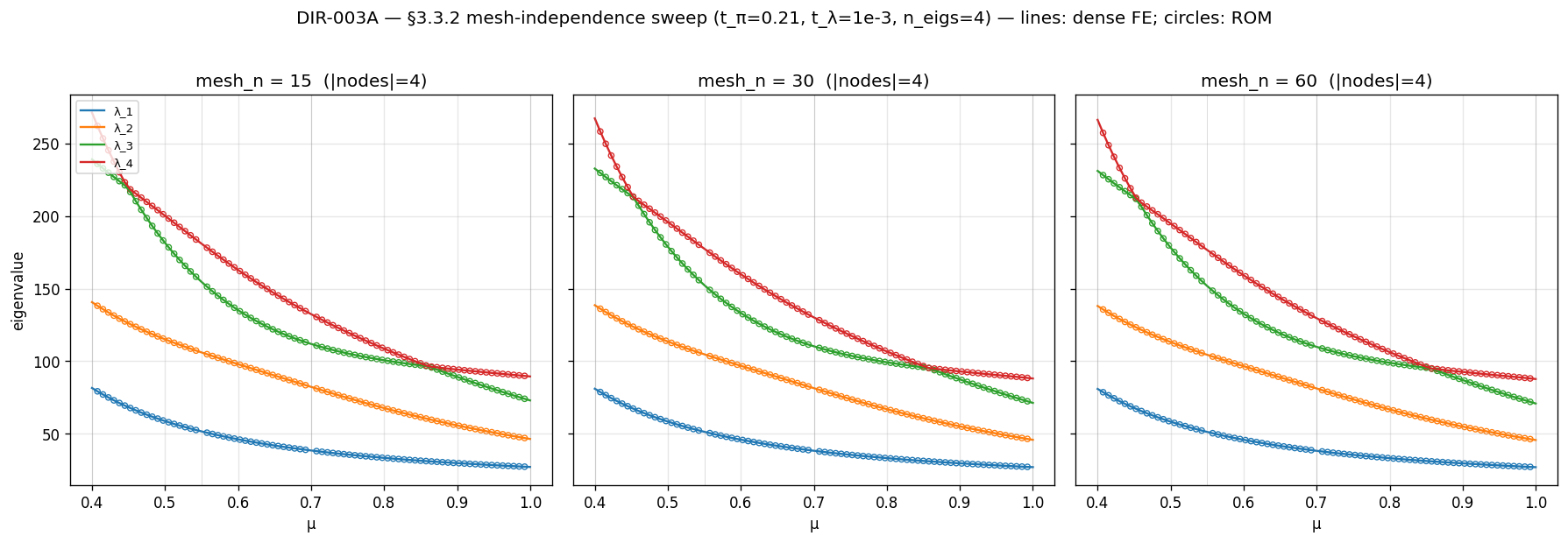
The converged adaptive grid, the surrogate accuracy, and the eigenvector subspaces all agree across the three resolutions: the algorithm’s behaviour is a property of the continuous eigenproblem, not of the discretisation chosen to solve it.