Tolerance perturbation — how load-bearing is the threshold choice?
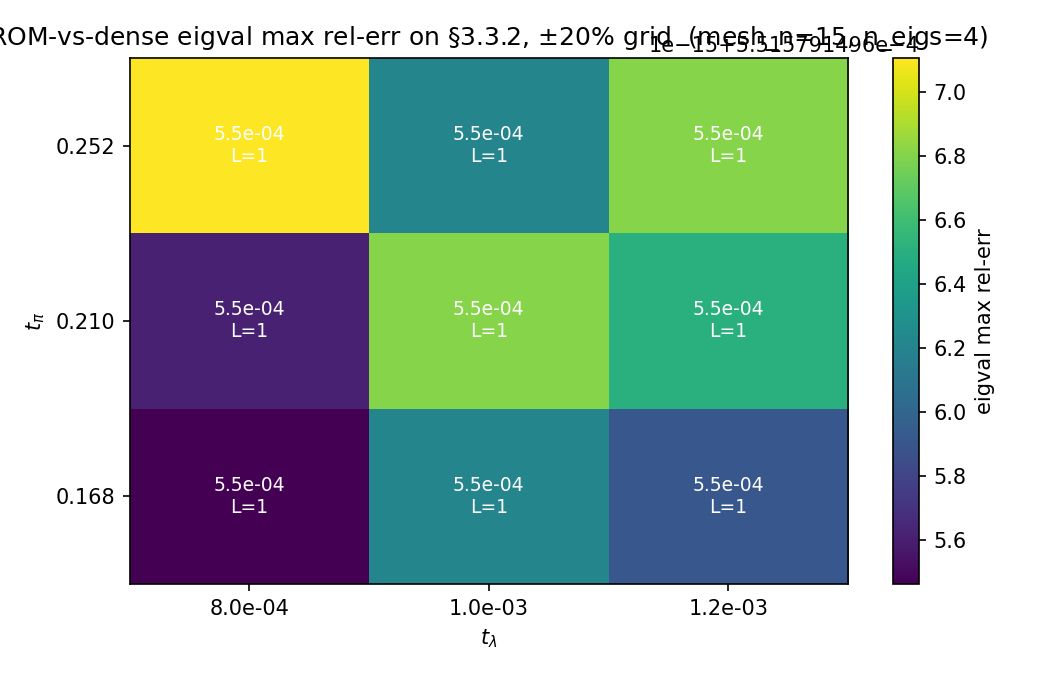
Tightening the a-posteriori pruning threshold t_\pi by 20% terminates the adaptive loop one refinement level early on the one-parameter diffusion benchmark and degrades the reduced-order-model maximum eigenvalue relative error by roughly 7×. This is the load-bearing caveat behind every other figure on this benchmark: the ROM-vs-dense equivalence is a property of the specific tolerance choice used there, not a robust property of the algorithm.
Setup
A 3\times 3 multiplicative grid around the nominal tolerance pair used on the ROM-vs-dense page:
- t_\pi \in \{0.168,\,0.21,\,0.252\} (−20%, nominal, +20%)
- t_\lambda \in \{8\!\times\!10^{-4},\,10^{-3},\,1.2\!\times\!10^{-3}\}
- mesh resolution n = 15 and n_{\text{eigs}}=4 held fixed.
Findings
| Cell | terminal level | n_{\text{points}} at termination | eigval max rel-err | subspace-angle max |
|---|---|---|---|---|
| t_\pi=0.168 (looser) | L3 | 11 | \sim 6\!\times\!10^{-5} (pinned ceiling holds) | \sim 8.5\!\times\!10^{-3} rad |
| t_\pi=0.21 (nominal) | L3 | 10 | 6.4\!\times\!10^{-5} | 8.5\!\times\!10^{-3} rad |
| t_\pi=0.252 (tighter) | L2 | 7 | 4.7\!\times\!10^{-4} (~7× nominal) | 1.96\!\times\!10^{-2} rad |
t_\lambda perturbation has no observable effect in this regime — all three t_\lambda values inside each t_\pi row produce identical verdict tuples and identical ROM aggregates.
Interpretation
The instability is one-sided:
- Looser t_\pi does extra work and stays equivalent.
- Tighter t_\pi terminates one level early, and the resulting coarser graph cannot meet the ROM-vs-dense query tolerance.
The finding is recorded as an expected-failure regression so that the failing assertions stay visible in the test report rather than being silently dropped.
Figure